When You Don’t Know What You Want.

What’s the difference between buying breakfast cereal and shopping for a TV?  Back in the day, an economist would have said there’s no difference; individuals always make rational decisions based upon preexisting preferences.  But that’s crazy—of course there’s a difference.  People purchasing cereal are usually making a regular, frequent purchase.  They know what they want (whole grain, no added sugar, no store brand, etc.), and their selections are informed by those preferences.  Buying a TV is a different kettle of fish.  The typical TV buyer hasn’t bought one in about four years.  In that time the category will have changed dramatically—new technologies, new features, new usage occasions, etc.  So TV shoppers generally feel confused and overwhelmed—they really don’t know what they’re looking for, or even what’s important to them.  As a qualitative researcher, I’ve noticed that this creates a much more complicated—messy, even—decision-making process.  Researchers and marketers must take these factors into accounts when conducting research and creating marketing strategies.
In essence these two processes are driven by what I call preference constructivity.  (To be honest, I’m not sure ‘constructivity’ is actually a word, but I use it anyway.)  The idea is that there are two types of decision-making processes: one in which the person making the decision has established, well-defined preferences, and one in which no such preferences exist to guide a decision.  The second one is called a constructive choice, because the individual has to construct his or her preferences while trying to also make a decision, while the first one is (obviously) called a nonconstructive choice.  Clearly, constructive choices are much more difficult and complicated than nonconstructive ones.
And, out of this comes one of my favorite analytical tools: constructive and nonconstructive mindsets.  Whenever I’m conducting research into consumer decision-making, one factor I’m always sure to probe is whether the research participants have well-defined preferences that can facilitate the process.  Sometimes this question is easily asked … “what’s important to you here?”  “What are the specific features and characteristics you’re looking for?”, but it can be tricky, as people aren’t always willing to admit their ignorance (think of a 20-year-old man in a car showroom).  So, I often find that I have to determine the existence of preferences through observation rather than through conversation.  That’s why I consider it a good practice to build into most research studies that seek to understand things like decision-making and the path to purchase methodological tools that allow us to observe shopping behavior.  This can be done via ethnographic approaches (immersing yourself in a shopping environment and watching how people shop), by conducting shop along research in which participants have an opportunity to shop on their own, and with usability labs that allow the researcher to observe and record online shopping behavior.
Determining the shopper’s mindset is crucial to understanding their behavior and to developing strategies and tactics that will be effective.  For instance, if shoppers are in a nonconstructive mindset, and know exactly what they’re looking for, it makes sense for the purchase process to be as linear and simple as possible.  But when shoppers are struggling to understand their options and are trying to figure out what their preferences are, resources that can easily inform them of key product features and capabilities and the benefits that accrue from them may be essential to converting a shopper to a purchaser.


On the Benefits of Generosity.

I often find myself thinking about my father this time of year.  The anniversary of his death is this Friday.  I learned a lot of things from my dad, including the importance of getting every last crumb off of a muffin wrapper, the difference between and rate variance and volume variance and the proper use of a wood chisel.  But the most important thing I learned from him is generosity.  For me, that was his defining virtue.  Dad was generous with his time, his wisdom and expertise, his affections and his money.  He truly believed in the idea of tikkun olam—repairing the world—and devoted himself tirelessly to many causes.  He always had time for us.  And if he was sometimes a little too forthcoming with assistance, that’s something I find it easy to forgive.  The result of this, of course, was that all of us who were close to him relied on Dad very heavily.  I know I did.  But I don’t think he would have had it any other way.  Because, more than just the family patriarch, Dad viewed himself as a caretaker.  He saw taking care of others as not just an obligation, but as a privilege, and a source of great fulfillment.  I’ve tried hard to follow this example—I haven’t always succeeded, but I’ve given it my best shot.
People devote a great deal of thought, angst, hand-wringing and naval-gazing to the question of the meaning of life, to the point that libraries are filled with the books on the subject.  But what I learned from my dad’s example was that this isn’t a complicated question at all.  There is ample purpose to be found in devoting yourself to others.  So, stop worrying about yourself, and start thinking about your fellow humans.  You can live a small life that’s all about you, or a big life that’s about others.
In addition to striving for generosity in my personal relationships, I’ve also tried to apply this principle to my professional life.  Treating colleagues and partners generously is usually good business, and it’s a better way to live.  It feels good to share your knowledge, experience, contacts and opportunities.  Keeping all that to yourself won’t do much for your reputation, and it’s also a crummy way to behave.
Furthermore, as a qualitative researcher, I’ve found generosity to be an important ingredient for success.  One term of art we quallies use frequently is UPR—unconditional positive regard.  This principle is closely associated with the thoroughly-fabulous-in-all-respects Naomi Henderson, one of the true pioneers of our profession.  The idea behind UPR is that you should assume the best of the people who are participating in your research.  They are being generous with their time and thoughts, and you should repay this generosity in kind.  Generosity also applies to how I manage conversations during interviews and focus groups.  Trust and respect are important ingredients to great conversations.  In addition, keeping research participants focused and on a short leash might be time efficient, but it won’t foster an environment of honesty and respect, and it won’t allow space for the unexpected to come up.  To do that, it’s important to give people the opportunity ramble a bit, go off on tangents, ask questions and share stories about their cats.
Lest you think that this is all just wooly-headed, feelgood nonsense, it’s important to remember that generosity has been observed in nearly all complex animal species and carries significant evolutionary advantages.  It’s not simply kill-or-be-killed out there.  While that type of behavior may exist between species, within species organisms tend to cooperate far more than they compete.  As psychologists Vladas Griskevicius and Douglas Kenrick have pointed out, all behavior is driven by seven underlying evolutionary imperatives:
  • Evading physical harm
  • Avoiding disease
  • Making friends
  • Attaining status
  • Finding a mate
  • Keeping a mate
  • Caring for family
With the possible exception of the first two, it’s pretty clear that giving of yourself—altruism— plays a crucial role in achieving these goals.  I’ve found evolutionary psychology and the role ancestral motives play in modern behavior to be essential to understanding consumer perceptions and decision-making.  Perhaps I’ll write a future blog post on this topic—stay tuned.
So, go ahead—be generous.  It’ll make you feel good and it will serve you well personally and professionally.  And anyway, it’s baked into your genes, so resistance is futile.

Understanding is Overrated.

If you know me, you’ve probably noticed that I love analytical models.  During my career I’ve made a point of collecting these tools and applying them to the work I do for my clients.  I find these tools to be invaluable and rely upon them heavily – they make me a better researcher.  By drawing upon the thinking of very smart people, we can make ourselves that much smarter.  However, I’ve also learned to be judicious in how I use these tools.  As the statistician George Box famously observed, “All models are wrong, but some are useful.” The reason Box called them ‘wrong,’ is that models are – by their fundamental nature – oversimplifications.  And, while over-generalization can be powerful analytical technique, we must use it cautiously, and with full awareness of its limitations and risks.
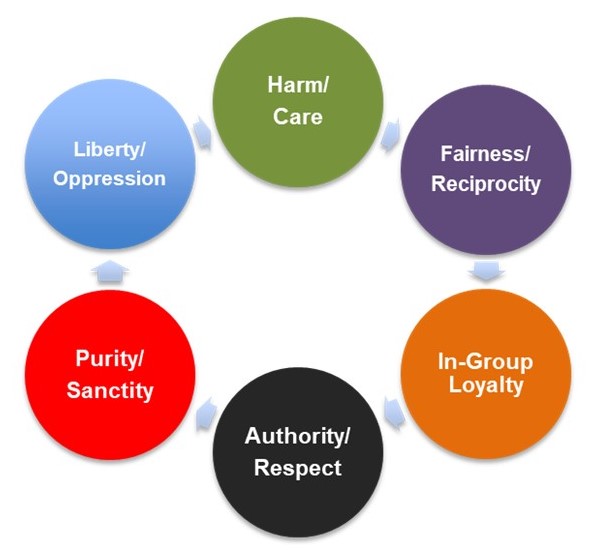
I love a pretty diagram with colored boxes and circles and arrows as much as the next guy, but I regularly remind myself that such a diagram represents a simplistic version of reality, not reality itself.  The human world is a lot messier.  Take, for example, Jonathan Haidt’s Moral Foundations Theory model, depicted at the top of this article.
This is an indispensable tool that I use frequently—it’s great for helping us think about the role morality plays in forming perceptions and driving behaviors.  However, morality in the real world is a bewilderingly complex tangle of psychological motivators, evolved traits, cultural norms and social dynamics.  While Haidt’s model is valuable, we should never make the mistake of thinking morality can be reduced to six little colored circles.
Here’s a common tool marketers use: the consumer decision tree – also often called the purchase decision hierarchy.  This type of representation is essential for understanding consumer decision-making and buying behavior. A lot of shopper insights work I do is designed around this technique.  However, consumer decision-making is a not a neat process at all.  It’s not really a decision tree, it’s more like decision soup, and all we can realistically hope to do is identify commonalities and tendencies.  This isn’t to say that we shouldn’t engage in the exercise of creating the tree; we just have to be mindful of its limitations.
Another example: consumer segments.  When we do segmentation studies, once a segmentation solution has been identified, we often like to give the individual segments interesting names and even write up personifications.  This is a worthwhile exercise, but it’s valuable when looking at the results of a segmentation study to examine the underlying data for yourself, rather than just relying upon the segment names and descriptions.  You’ll probably see pretty quickly that the true picture is much more complicated, contradictory and nuanced.
The bottom line –  sometimes we work too hard to understand. We want our explanations to be too pat, and way too all-encompassing.  Be suspicious of descriptions that are extremely simple.  Instead, revel in the messiness.  Put another way, don’t let an analytical model become a surrogate for thought.  Models facilitate and organize our thinking, but they’re no substitute for careful analysis.
And remember what H.L. Mencken once wrote: “there is always a well-known solution to every human problem — neat, plausible, and wrong.” 

On Why Being Poor Is Expensive.

I appreciated the response to my recent post on maximizing and satisficing mindsets.  So many of you had great comments and anecdotes to share.  This type of analytical tool—mindsets—seems to be of interest to marketers and researchers.  So, here’s another one: scarcity.
About a year ago I was presenting shopper insights research to a category management team from a retailer that serves low-income shoppers.  At one point, when I was describing shopper decision-making behaviors, a buyer said to one of the merchandisers, “our customers really are just stupid, aren’t they?  I guess that’s why they’re so poor.”  The merchandiser agreed.  I’ve replayed this scene repeatedly in my mind many times since, mainly because I remain so disappointed in my own reaction to this exchange—I didn’t say anything.  Maybe I was worried I could create an awkward situation, perhaps I didn’t want to jeopardize the relationship between the retailer and my client (an OTC manufacturer), maybe I was just too shocked to respond.  But I wish I had.  Because, the truth is, I knew that buyer was wrong.
Viewed from a distance, it’s easy to see low income individuals as making problematic, self-destructive decisions, such as poor adherence to medical regimens, bad time management, irrational financial choices, etc.  To a large extent, these behaviors are what perpetuate the cycle of poverty.  Similarly, people who are chronically pressed for time always seem to be behind, never able to catch up.
But low-income shoppers are NOT stupid.  Neither are they irrational.  Rather, their perceptions and behaviors are profoundly influenced by scarcity, and scarcity has its own logic.
Nearly all of us experience some sort of scarcity at some point in our lives.  There are seven general categories of resources for which we can experience shortages:
  • Money
  • Time
  • Physical space
  • Nutrition
  • Water
  • Allowable mistakes
  • Socialization
Somewhere along the line you’re almost certainly going to find yourself short of at least one of these: you’ll be out of cash, underfed, lonely – whatever – and that will change you.  You’ll see things differently than you would if you had these things in abundance.  In other words, you’ll be in a scarcity mindset.
Here are some things you need to know about the scarcity mindset:
  • It requires one to make constant, zero-sum tradeoffs—either you buy the big package of allergy medicine and get a great price per pill, or you buy the small package, pay a lot per pill, and have enough money for food this week. You can’t do both.  As the writer James Baldwin once observed, ‘being poor is expensive.’
  • It makes one highly sensitive to required resources—you know you only have 31 minutes to get your kids up, dressed, fed and off to school. The five minutes your daughter just told you she needs to finish her homework simply will not fit into the morning routine.
  • ‘Normal’ levels of scarcity are healthy; they enable focus and discipline. However, chronic, severe scarcity leads to tunnelingfocusing on the scarce resource to the exclusion of nearly everything else.  Neurosurgeons are under enormous pressure in the OR—they have very little time to complete a procedure, and absolutely cannot make a mistake.  As a result, they tend to hyper-focus on the task at hand to the exclusion of everything else—such as trying that cool new surgical instrument they’ve been hearing about.
  • Scarcity makes one less intelligent. Experimental psychologists quantify this effect at 13-14 IQ points, which can be the difference between average and gifted or average and deficient.  Behavioral scientists Sehdhil Mullainathan and Eldar Shafir (who have written a fantastic book about scarcity) famously demonstrated this while studying sugarcane farmers in India.  These farmers only get paid once a year, when they sell their harvested crop.  In the year that passes between harvests, testing shows their IQs drop substantially as they go from being rich to being poor.
  • Scarcity taxes cognitive capacity and executive control (the ability to rein in our impulses), significantly reducing both. Dieters, who are, by definition, deliberately undernourished, have been demonstrated to have difficulty evaluating food choices and resisting their cravings (no wonder they can’t lose weight).
All of this leads consistently to sacrificing the future for the present—in other words – we become our own worst enemies. Here are some key implications for marketers and researchers:
  • First of all, just think about scarcity. Ask yourself, is deprivation somehow influencing consumer perceptions and behaviors?  What resources are insufficient in consumers’ lives?
  • If you’re a marketer, do you need to account for scarcity in your brand communication? Your pricing and packaging?  Your promotional tactics?
  • If you’re a researcher, do you need to build this issue into your questionnaire or discussion guide? Getting people to talk about scarcity can be challenging.  They often have difficulty articulating what’s in short supply and how that affects them.  Personally, I’ve had good luck with sentence completion exercises like, “If I only had more ‘Of This’, I’d be able do to ‘More Of That’.  This provides a structure in which a research participant can describe scarcity and its results.
Scarcity is a powerful mindset.  It’s a lens that changes—and sometimes distorts—how people see things and behave.   If we don’t account for it when trying to understand attitudes, perceptions and actions, we’re missing a big part of the picture.
One final thought: there’s also such a thing as an abundance mindset.  It can cause just as much dysfunction in perceptions and decision-making as scarcity.  I’ve done a lot of research among high-net worth individuals, and they often seem to be every bit as irrational as low-income people, just in different ways.

Dad Jokes Are Funny, But Dads Aren’t a Joke.

Dads, and their role in society and the family, are changing.  Schools have noticed it.  I, as a researcher who regularly conducts studies specifically among dads, have noticed it.  And marketers have noticed it.
Dads are becoming increasingly important to marketers, with good reason.  They play a crucial role in purchasing and family decision-making, and ignoring them could be bad for business.  However, marketers and advertisers continue to make the same mistakes with dads that they’ve been making for decades, including:
  • Treating them like moms
  • Treating them like other men
  • Treating them like dads of the past
  • Treating them like idiots
Having done research among dads for many years now, they continue to surprise me.  They continue to change, and the pace of change seems to be increasing.  Some of these changes are widely reported – such as their greater involvement in parental and household tasks and greater involvement in family decision-making) – while others are less well-known.  Here’s one, for instance; dads feel much more pressure lately to be nurturers as well as providers, and these pressures clash with each other.  As noted clinical psychologist Dr. Gail Winbury has observed, “fathers feel they’re being encouraged to attach emotionally to their children to a much greater degree than even a few years ago.”  And this pressure brings internal conflict—while they’re expected to be nurturers at home, dads still feel clear pressure to leave the house every day and slay dragons.
Winbury again: “Fathers are profoundly conflicted.  They’re receiving complex and often contradictory messages.”  These messages come through the media and their own social networks, and create a sense that nothing they do will ever be entirely correct.  As one recent focus group participant dad observed to me, “I feel like, no matter what I do, I’m going to be told I screwed up.”  
So, here’s what I think marketers need to do:
  • Stop making outdated assumptions. Realize that fathers today bear little resemblance to dads of the past, that they’re significantly different from moms in their attitudes and behaviors, and they don’t like being portrayed as being clueless.  The biases and misconceptions that marketers continue to build into their marketing strategies and tactics toward dads often render them ineffective.
  • Do some research. Get to know the dads of today.  This can be done in a variety of ways.  Qualitative tools and custom quantitative approaches are worth the resources.  In addition, social media listening and syndicated data can also inform your understanding of dads.  But, as with the previous point, be careful of the assumptions you might be making when conducting this research.  Also, bear in mind that, as dads continue to change, you’ll probably need to refresh this research regularly.
If marketers really listen to dads, avoid stereotypes, and are sensitive to the tightrope fathers are being asked to walk, they can become an important stakeholder to a brand.