
The Collaboration You Probably Don’t Know About.

There’s no substitute for experience and expertise.

We have been collaborating on research that combines qualitative methods and advanced technology for about 15 years. However, we’ve never actually told the world about this. So, here goes.

Market research is a team effort. High-quality outcomes require that all participants do excellent work and know how to work together. Today’s evolving landscape often requires the integration of traditional qualitative research with behavioral and emotional measures such as eye tracking and biometrics.  A high degree of experience working with these tools – and working seamlessly – is essential to producing quality results that yield unexpected insights.

Combining advanced technology with qualitative methods is an unbeatable combination. It allows us to uncover what people really notice and respond to – often beyond what they can articulate themselves. But only if everybody involved understands the tools and techniques.

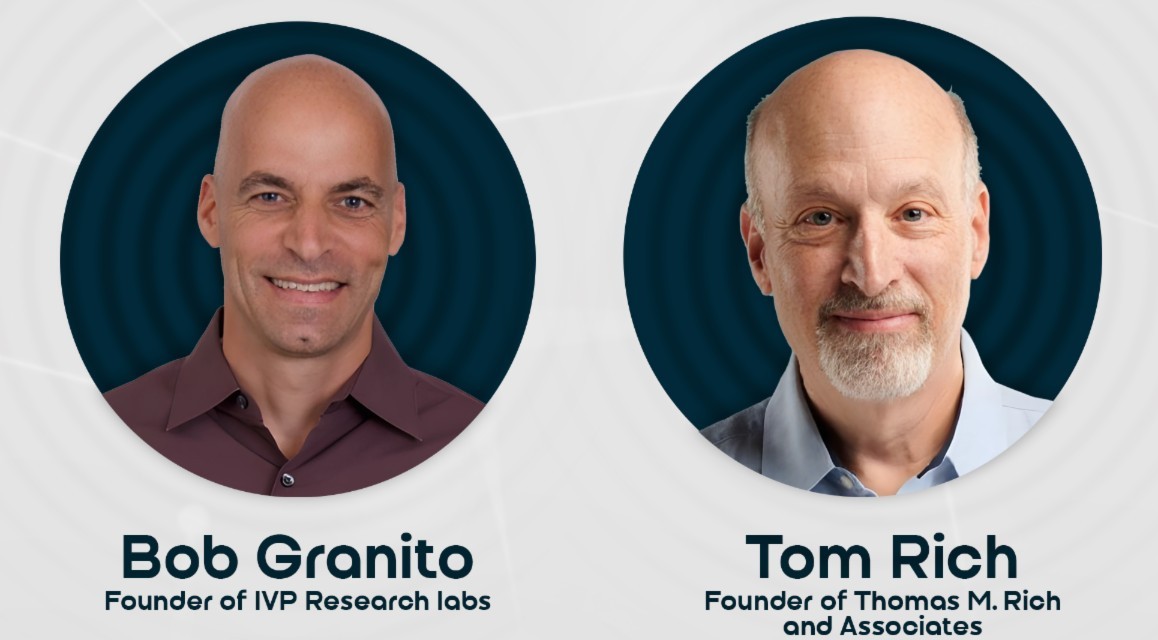
We have worked together dozens of times on this type of research. Bob provides the advanced technology. Tom handles the qualitative research design, execution and analysis. This combination yields outstanding results because IVP is the leading provider of eye tracking and biometric technology to the market research world, and Tom is widely known for combining these tools with qualitative methods.

People often view biometrics as a plug-and-play solution. But success depends upon more than sophisticated equipment. If the qualitative researcher moderating the study doesn’t understand eye tracking or biometrics, important opportunities will be missed. The study design could be flawed, important questions might not be asked, perceptions might not be probed, and valuable insights will never surface.

What’s more, collecting and analyzing biometric data is both art and science. If the people responsible for the technology aren’t experienced, you could easily end up with useless data and wasted time and money.

The same principle applies on the back end. Biometric data has little value unless those responsible for its analysis understand marketing strategy, motivation, and decision-making. This allows data to be translated into meaningful stories and actionable insights.

That’s why collaboration matters. Successful studies occur when all parties understand one another’s disciplines. The difference between a good study and a great one is ensuring that every link in the chain is strong from the beginning to the end.


Why False Things Sound True.

Remember when we all thought the world was flat?   

We don’t believe things because they’re true. We believe them because they’re easy to believe.  As a qualitative researcher, one of the main things I do is help my clients understand how people form opinions and make decisions. Do this long enough and you’ll notice that people believe some crazy stuff. So, I regularly need to figure out why people believe things that are demonstrably untrue.

We live in a world inundated with information. What’s more – newsflash! – a lot of the information we encounter is incorrect. Sometimes this inaccuracy is inadvertent, sometimes it’s deliberate. Figuring out what’s true is increasingly important. And one thing that can make this particularly challenging is that sometimes things that aren’t true just sound like they are.

Cognitive psychologists have a term for this: ‘the illusory truth effect.’ It’s our tendency to believe something simply because it’s familiar – we’ve heard it repeated many times over a long period. This repetition increases what’s called ‘processing fluency,’ which is a fancy way of saying that something is easy to think about. Our brains then mistake that ease for accuracy. If you’ve been told your entire life that the earth is flat, that doesn’t just sound true, it sounds obvious.

I see this as being a problem. When something intuitively sounds true, we’re likely to take it at face value and not challenge it. And this is how lies spread virally. I’m reminded of that remark attributed to Mark Twain about how a lie can travel halfway around the world before the truth can put its pants on. (Actually, there’s no proof he ever said that, so maybe this is illustrative of my point.)

The increasing importance of social media and artificial intelligence makes this a particularly urgent issue, as these tools play a significant role in perpetuating untruths. Social media algorithms amplify repetition, and repetition drives the illusory truth effect. These algorithms also magnify saliency – they make things seem more significant than they are. These factors put a lot of responsibility on each of us individually to vet information.

This isn’t something for which any of us has the power to effect broad change. We need to focus on our own thinking patterns.  This means getting in the habit of questioning conventional wisdom. Because  a lot of conventional wisdom out there is complete nonsense.

So, when something is easy to believe, be suspicious. The fact that it’s easy doesn’t make it true.

What’s In A Name?

The Bloody Mary Principle.

In the world of marketing, there’s no harder job than naming a brand or product. As a qualitative researcher, I’m always looking for and developing creative ways of evaluating names that will be reliable and insightful. A lot of factors make naming difficult. Here are just a few:

Names need to do a lot. Among other things, they need to be memorable, legally ownable, able to communicate brand benefits, emotionally resonant, and free of negative associations.

They’re hard to think about rationally. The first time we hear a truly new name it lacks meaning. It’s just a sound – an empty vessel. It’s very difficult to connect that sound with a specific concept or emotional response.

Good names often don’t ‘feel right’ at first. Rather, a product or brand grows into a name. Successful brands teach us how to interpret their names over time. Think about some brands and products that were successful despite starting with what was seen as a ‘bad’ name: iPod, Google and Pepsi come to mind.

And here’s one more major challenge; once a name is associated with something, it’s hard to change how we think about that thing. For instance, I love a Bloody Mary, but I’m allergic to horseradish. Unfortunately, when I order one without the offending ingredient, the response is usually “sorry, no-can-do, they’re pre-mixed.” But if I order vodka and tomato juice with seasonings, suddenly it’s not a problem. By not calling a beloved cocktail by its name – rather describing it in terms of its ingredients – things suddenly become more flexible. Once a name becomes established and fixed in our minds, it’s tough to perceive something independent of the name itself.

This challenge seems particularly important in our world today. I recently wrote about how words matter. We need to be careful to use language accurately and honestly. This need is especially acute when we’re using a name – a word that designates something specific. When a politician brands an opponent a ‘fascist,’ or a company that’s firing people labels it ‘right-sizing,’ they’re harnessing the power of a name in a way that’s probably intended to mislead.

A final point – it’s important to remember that a name isn’t the actual thing we associate with it.  Rather, a name is a proxy for something concrete – a symbol. Symbols are powerful. They profoundly influence how we perceive and think about reality. But, in the end, they’re just symbols, not the actual things. In order to have honest and productive conversations, we need to look beyond the name being used and focus on what’s actually being discussed.

Credit goes to my daughter Elizabeth, who selflessly field-tested the Bloody Mary hypothesis. Thanks also to my friend and colleague Maria Virobik for supplying the Bloody Mary above, and who drank it up shortly after I took the picture.

It’s All About You, Darling.

Why are we always looking in the mirror?

I’ve long been fascinated by psychics. Recently I’ve given presentations to market researchers on the question of whether techniques from the mystical arts can be applied to qualitative research (spoiler – they can!). One thing that I’ve come to appreciate in my study of this topic is the willingness of people to take the pronouncements of psychics, no matter how general, as being uniquely applicable to themselves. For instance, a psychic might say something like, ‘you can be very hard on yourself.’ This is a statement that could apply to anybody. But, to the person on the receiving end, it sounds personal and profound.

This is the power of what psychologists call ‘subjective validation,’ which is a fancy way of saying that we tend to make everything all about ourselves. Specifically, it’s a cognitive bias that leads us to assume that information is correct if it has personal meaning or significance to us.

This is an ever-present mental habit. We need to be on guard for it, as it can lead us astray in our thinking. It can cause us to engage in thought patterns that can be counterproductive. For instance:

We mistake resonance for accuracy. We’ve all done this. You see or hear something, and it just ‘clicks.’ The fact that something intuitively resonates is important, but it’s also important to remember that what you’re responding to may not be accuracy, but that it fits your self-image. This can be a problem, as it stops you from continuing to evaluate because you’re already convinced.

We embrace self-perpetuating personal narratives. Our perceptions of ourselves – “I’m a risk-taker!” or “I’m a people person!” – lead us to interpret events in ways that confirm our narrative. This causes us to ignore or reinterpret facts that conflict with our self-image in order to make everything fit. This can be a problem because a story that explains everything is a story that can’t be corrected.

As a marketing strategist and qualitative researcher, I make a point of exploring how research participants’ self-images inform how they shape opinions and make decisions. This is valuable to clients, because understanding how consumers map themselves onto brands, products and services can be instrumental to developing effective marketing and brand communication strategies.

A final thought. We are a pattern-seeking species. We evolved in a dangerous environment in which being able to identify predators or prey quickly  was essential to survival. The environment has changed, but the tendency remains. However, due to our tendency towards subjective validation, often the pattern we are seeking is ourselves. So remember – it’s not all about you.

Should We Really Call It AI?

Probability Isn’t Intelligence. 

If you’ve been to a marketing or market research conference recently, you’ll have noticed that most of the content is either expressly or indirectly about artificial intelligence and how it applies to our field. Same for the trade press – it’s heavily focused on AI.

As with pretty much every other profession, AI tools have significantly changed market research. From writing a first draft of a questionnaire to streamlining analysis, they can be extremely valuable. As a qualitative researcher, I’ve found them to be quite helpful in certain, specific situations. For instance, they’re great for automating repetitive tasks and are also very good (probably better than humans) at identifying latent themes in qualitative data.

As indispensable as these tools are, it’s important to remember what they can and can’t do. AI pioneers like Judea Pearl and Gary Marcus have pointed out that the term ‘AI’ is something of a misnomer, as artificial intelligence isn’t truly ‘intelligent’ in the most commonly understood senses of the word.

Rather, AI tools are high-dimensional probability calculators. They are good at yielding output that eerily resembles intelligence and are amazingly good at finding correlations and hidden patterns. As such, these tools can help us come up with new, unexpected hypotheses for further investigation.  However, it’s essential not to skip that ‘further investigation’ part.

Using technology to automate tedious, recurring tasks or to sift through a huge, disorganized dataset is a smart practice. But, if you let a microchip think for you, not only are you asking for something it can’t actually do, but you are making yourself – as a carbon-based life form – superfluous.

Drawing new insights from data requires thinking. Managing a conversation in a spontaneous manner that leads to unexpected, insightful findings requires thinking. For now, at least, people will need to continue to do these jobs. So, if we want to stay relevant as humans, we need to lean into some uniquely human skills: critical thinking, inference, and nonlinear reasoning. Remember, probability and insight are not the same thing. True wisdom comes from things like intuition and lived experience.

When it comes to AI, a lot of the conversation seems to focus on efficiency. I like saving time and money as much as the next guy, but truly transformative qualitative research isn’t about efficiency, it’s about inference and insight in the face of uncertainty. For now, at least, that’s what the human mind is for.