

What’s In A Name?

The Bloody Mary Principle.

In the world of marketing, there’s no harder job than naming a brand or product. As a qualitative researcher, I’m always looking for and developing creative ways of evaluating names that will be reliable and insightful. A lot of factors make naming difficult. Here are just a few:

Names need to do a lot. Among other things, they need to be memorable, legally ownable, able to communicate brand benefits, emotionally resonant, and free of negative associations.

They’re hard to think about rationally. The first time we hear a truly new name it lacks meaning. It’s just a sound – an empty vessel. It’s very difficult to connect that sound with a specific concept or emotional response.

Good names often don’t ‘feel right’ at first. Rather, a product or brand grows into a name. Successful brands teach us how to interpret their names over time. Think about some brands and products that were successful despite starting with what was seen as a ‘bad’ name: iPod, Google and Pepsi come to mind.

And here’s one more major challenge; once a name is associated with something, it’s hard to change how we think about that thing. For instance, I love a Bloody Mary, but I’m allergic to horseradish. Unfortunately, when I order one without the offending ingredient, the response is usually “sorry, no-can-do, they’re pre-mixed.” But if I order vodka and tomato juice with seasonings, suddenly it’s not a problem. By not calling a beloved cocktail by its name – rather describing it in terms of its ingredients – things suddenly become more flexible. Once a name becomes established and fixed in our minds, it’s tough to perceive something independent of the name itself.

This challenge seems particularly important in our world today. I recently wrote about how words matter. We need to be careful to use language accurately and honestly. This need is especially acute when we’re using a name – a word that designates something specific. When a politician brands an opponent a ‘fascist,’ or a company that’s firing people labels it ‘right-sizing,’ they’re harnessing the power of a name in a way that’s probably intended to mislead.

A final point – it’s important to remember that a name isn’t the actual thing we associate with it.  Rather, a name is a proxy for something concrete – a symbol. Symbols are powerful. They profoundly influence how we perceive and think about reality. But, in the end, they’re just symbols, not the actual things. In order to have honest and productive conversations, we need to look beyond the name being used and focus on what’s actually being discussed.

Credit goes to my daughter Elizabeth, who selflessly field-tested the Bloody Mary hypothesis. Thanks also to my friend and colleague Maria Virobik for supplying the Bloody Mary above, and who drank it up shortly after I took the picture.
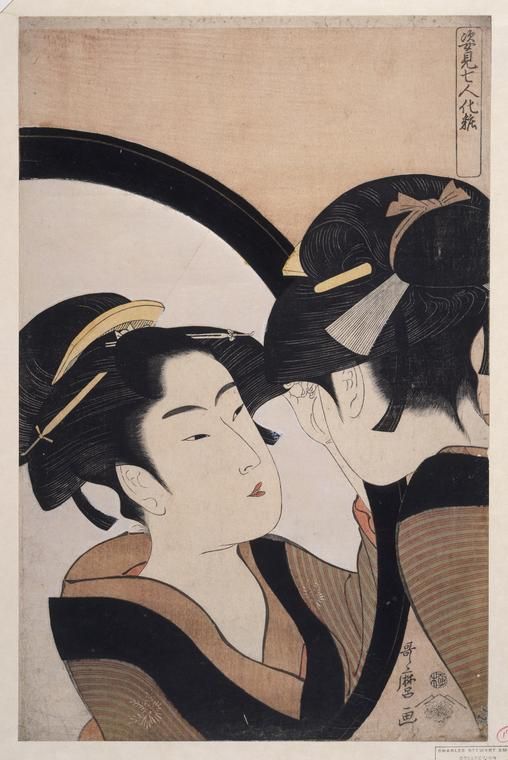

It’s All About You, Darling.

Why are we always looking in the mirror?

I’ve long been fascinated by psychics. Recently I’ve given presentations to market researchers on the question of whether techniques from the mystical arts can be applied to qualitative research (spoiler – they can!). One thing that I’ve come to appreciate in my study of this topic is the willingness of people to take the pronouncements of psychics, no matter how general, as being uniquely applicable to themselves. For instance, a psychic might say something like, ‘you can be very hard on yourself.’ This is a statement that could apply to anybody. But, to the person on the receiving end, it sounds personal and profound.

This is the power of what psychologists call ‘subjective validation,’ which is a fancy way of saying that we tend to make everything all about ourselves. Specifically, it’s a cognitive bias that leads us to assume that information is correct if it has personal meaning or significance to us.

This is an ever-present mental habit. We need to be on guard for it, as it can lead us astray in our thinking. It can cause us to engage in thought patterns that can be counterproductive. For instance:

We mistake resonance for accuracy. We’ve all done this. You see or hear something, and it just ‘clicks.’ The fact that something intuitively resonates is important, but it’s also important to remember that what you’re responding to may not be accuracy, but that it fits your self-image. This can be a problem, as it stops you from continuing to evaluate because you’re already convinced.

We embrace self-perpetuating personal narratives. Our perceptions of ourselves – “I’m a risk-taker!” or “I’m a people person!” – lead us to interpret events in ways that confirm our narrative. This causes us to ignore or reinterpret facts that conflict with our self-image in order to make everything fit. This can be a problem because a story that explains everything is a story that can’t be corrected.

As a marketing strategist and qualitative researcher, I make a point of exploring how research participants’ self-images inform how they shape opinions and make decisions. This is valuable to clients, because understanding how consumers map themselves onto brands, products and services can be instrumental to developing effective marketing and brand communication strategies.

A final thought. We are a pattern-seeking species. We evolved in a dangerous environment in which being able to identify predators or prey quickly  was essential to survival. The environment has changed, but the tendency remains. However, due to our tendency towards subjective validation, often the pattern we are seeking is ourselves. So remember – it’s not all about you.

You’re Never Too Young to Be Old and Grumpy.

Old habits die hard, no matter who you are.
ere is a case in point. Recently, I conducted qualitative research interviews regarding pharmaceutical websites. One participant was a RN who was also the office manager for a medical practice. She was quite young (at least by my standards) – in her late 20s.
Despite being extremely intelligent, she had difficulty navigating around and finding information on drug manufacturers’ websites. When we discussed why this was such a challenge, she revealed that manufacturers’ websites were not where she sought information. She had other online resources that she used, and those resources were organized differently. She pondered, “I guess I’m just set in my ways.”
She saw an unwillingness to depart from familiar habits as a trait of ‘older’ people. However, she admitted to being exactly that way herself. “I guess there’s a cranky, unteachable old person inside all of us,” she said.”
Being crotchety and incorrigible isn’t just for the old. Everybody gets set in their ways, and for good reasons. Habits are automatic behaviors that reduce cognitive load. They simplify tasks and provide efficiencies. Once you’ve established a habitual way of doing something, you don’t have to think about it.
The key to success is knowing when to stick with what works, and when to depart from that and embrace the new. It’s the difference between ‘if it ain’t broke, don’t fix it’ and ‘if it ain’t broke, break it.’
Habits offer important benefits:
  • They ease mental burden. Habits obviate the need to make decisions, meaning you’re not working as hard between the ears.
  • They lead to predictable results. This is essential to efficiency and productivity.
  • They provide discipline. This creates structure and reduces procrastination.
However, habits also have downsides:
  • They make change difficult. Sometimes we must adapt to new or complex situations. However, habits can foster inflexibility.
  • They can breed boredom and complacency. This can lead to reduced motivation and engagement.
  • They can reinforce negative behavior patterns. When a habit is not helping you, perhaps even making a situation worse, it can be hard to break that pattern.
Ultimately habits – like rules – are surrogates for thought. Sometimes this is helpful, sometimes not. Long term success requires evolving over time as circumstances change. When the ground shifts, you need to start thinking. This requires adaptability and intentionality – qualities engrained habits don’t promote.
It’s also important to remember that habits might be hard to break because they can define our sense of identity. As Aristotle once wrote, “we are what we repeatedly do.” When a pattern of behavior becomes closely linked to your self-image, changing that pattern might feel like self-betrayal.
So, while it’s valuable to get in the habit of establishing habits, it’s also worthwhile to get in the habit of breaking habits. Rigidity and complacency are very human traits. Always be on the lookout for them.

Life is not an Edward Hopper Painting.

The real world is complicated and messy. And that’s what’s great about it.
I love Edward Hopper’s works. They carry a sense of simplicity and longing that have always resonated with me.
Hopper’s paintings are often described as melancholy, a quality that stems from their sparseness of composition and the isolation of the characters depicted. But, to me, this also illustrates the opposite idea: that much of the joy and exuberance of life comes from human relationships and the fact that the world is complicated and messy.
Take a look at the image at the top of this newsletter. Nighthawks is probably Hopper’s most famous work. It’s a beautiful composition of stillness, stark lighting and characters lost in their own thoughts. And, I don’t know about you, but that’s probably the neatest, calmest diner I’ve ever seen. Think about what a real diner would be like: signs all over the walls (try our corned beef hash!), plates of food and cups of coffee in constant motion, people engaged in animated conversation and waitresses calling everybody “hon.” And that’s why I love diners.
So, here’s an important thing to remember this time of year—if you try to be too perfect, if you try to make everything just so, you’re likely to squeeze all the life out of what’s going on. The holidays are often a fraught time of year, and it doesn’t help to beat yourself up over everything not being as neat and organized as it ‘should’ be. Allow yourself to enjoy the hullabaloo that generally accompanies the holidays.
I wrote a year-end piece a few years ago about what I call ‘The Dirty Harry Principle.’ It’s about a closely related idea: knowing your limitations, being comfortable with them, and not needing to be perfect all the time, particularly this time of year. It’s a message worth a few minutes of your time.
There’s an important implication here for my field of qualitative research: don’t try to make conversations and research stimuli overly neat and orderly. Let them be kind of messy to create energy and simulate reality. For example, overly simple and clean renderings of a retail shelf set may produce misleading results because actual retail environments are so cluttered and untidy. Also, real-world conversations generally don’t involve everybody taking their turn to speak—they can be pretty chaotic. While quantitative research needs to be controlled and structured in order to generate representative and projectable data, qual doesn’t need to do that. So let the turmoil work for you.
My previous newsletter was about how decision making in the real world tends to be messy, impulsive and irrational. Decision making isn’t the only human phenomenon that’s kind of wild. We’re just a crazy species. So embrace that old adage:  God bless this mess.

The Slippery Slope of Apathy.

Perhaps you’ve noticed we’re living in tense times
Disagreements seem to dominate the public sphere and our private lives. How we approach these differences is more urgent than you might think.
Being a qualitative researcher requires interest in, and empathy towards, the opinions and beliefs of others. It’s part of the fundamental ethos of the field. So I have a professional obligation to identify with others.
I once wrote a piece about ‘the debating society principle:’ the idea that we have a responsibility to understand opinions contrary to our own. Since then, I’ve had conversations with more than a few people who disagree with this premise. They are entirely apathetic towards different opinions and view even trying to understand such perspectives as being somehow immoral. They feel no need to agree to disagree. This has become a particularly acute issue, being that we are living in highly polarized times.
Having empathy for someone with whom you differ doesn’t require you to agree with that person. It simply asks you to respect the person and try to see things from his or her perspective.
The idea that it is OK – if not laudable – to have no interest in a point of view different from your own brings to mind the philosopher and civil rights leader Rabbi Abraham Joshua Heschel, who once wrote that “the opposite of good is not evil; the opposite of good is indifference.” Being indifferent to the beliefs and feelings of another person strikes me as the first step toward dehumanizing that person. Once we start seeing some individuals as being less than fully human, bad things start to happen. If you’re wondering why we seem to be in a period of such profound societal and political dysfunction, perhaps this helps to explain that.
Being uninterested in the beliefs of another human being – and perhaps dismissive of that person’s fundamental humanity – puts you on a slippery slope. It places you in danger of becoming something you never wanted to (or even thought you could) be.
We’re in a particularly fraught time right now, as we’re only a few weeks from an election. No matter what your political point of view, realize that about half of your fellow citizens probably disagree with you on at least one major issue. This brings you face-to-face with a crucial choice: will you view opinions that are contrary to yours with empathy or apathy? Your own humanity may hang in the balance.