During a focus group among foodservice professionals, one participant said to another …
… “your restaurant is never going to make money. I’m just saying.” The second participant neither appreciated nor agreed with this statement. But it started a good, if emotional, conversation.
At one point I quoted what the first participant had said, including the ‘just saying’ part, and asked why he had added that. He thought a bit and admitted that he had included it without thinking about it. Eventually he realized that he was trying to be less harsh. This led to further discussion about the intense emotional commitment restaurant owners make to their businesses, which surfaced important insights for the client, a food manufacturer.
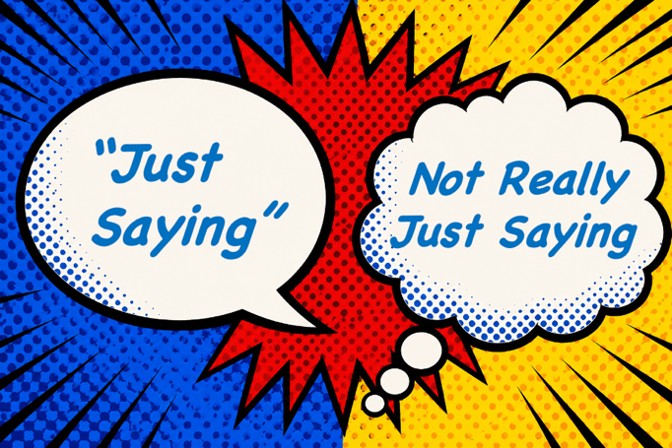
‘Just saying’ is one of those phrases we sometimes use without thinking. It’s what’s technically called a discourse marker – something that indicates how somebody wants a statement to be interpreted. Specifically, it signals that the speaker wants the remark to be heard in a particular way – or to avoid responsibility for how it might be taken. As a qualitative researcher, I pay close attention to these markers, as they can be clues to hidden meaning. I’ve learned that when somebody adds in ‘just saying,’ they’re probably not just saying. While ostensibly it means that somebody is merely making an observation, it usually means more.
Specifically, it might indicate the speaker is trying to:
Soften criticismby making it seem less personal or confrontational. Create plausible deniabilityif the remark is challenged or poorly received. Imply something without stating it outright leaving the listener to connect the dots.
So, by exploring these markers when we encounter them and questioning why the speaker included one in a statement, we can learn more about a person’s true meaning and feelings. In addition to ‘just saying,’ here are a few more discourse markers that I watch for, as they suggest veiled subtext:
‘For what it’s worth…’ signals modesty while asking the listener to take the opinion seriously. ‘No offense, but…’ acknowledges that offense is likely while attempting to soften it. ‘Don’t take this the wrong way, but…’ is a way to soften criticism. ‘With all due respect…’marks disagreement while paying deference. ‘Not for nothing…’ suggests a point deserves more attention than it’s getting. ‘I’m just asking the question…’ frames an implication or challenge as mere curiosity.
So, when you notice a discourse marker in the course of conversation, dig in. You’re likely to learn a little more, and maybe even a lot more.
There’s no substitute for experience and expertise.
We have been collaborating on research that combines qualitative methods and advanced technology for about 15 years. However, we’ve never actually told the world about this. So, here goes.
Market research is a team effort. High-quality outcomes require that all participants do excellent work and know how to work together. Today’s evolving landscape often requires the integration of traditional qualitative research with behavioral and emotional measures such as eye tracking and biometrics. A high degree of experience working with these tools – and working seamlessly – is essential to producing quality results that yield unexpected insights.
Combining advanced technology with qualitative methods is an unbeatable combination. It allows us to uncover what people really notice and respond to – often beyond what they can articulate themselves. But only if everybody involved understands the tools and techniques.
We have worked together dozens of times on this type of research. Bob provides the advanced technology. Tom handles the qualitative research design, execution and analysis. This combination yields outstanding results because IVP is the leading provider of eye tracking and biometric technology to the market research world, and Tom is widely known for combining these tools with qualitative methods.
People often view biometrics as a plug-and-play solution. But success depends upon more than sophisticated equipment. If the qualitative researcher moderating the study doesn’t understand eye tracking or biometrics, important opportunities will be missed. The study design could be flawed, important questions might not be asked, perceptions might not be probed, and valuable insights will never surface.
What’s more, collecting and analyzing biometric data is both art and science. If the people responsible for the technology aren’t experienced, you could easily end up with useless data and wasted time and money.
The same principle applies on the back end. Biometric data has little value unless those responsible for its analysis understand marketing strategy, motivation, and decision-making. This allows data to be translated into meaningful stories and actionable insights.
That’s why collaboration matters. Successful studies occur when all parties understand one another’s disciplines. The difference between a good study and a great one is ensuring that every link in the chain is strong from the beginning to the end.

 During a focus group among foodservice professionals, one participant said to another …