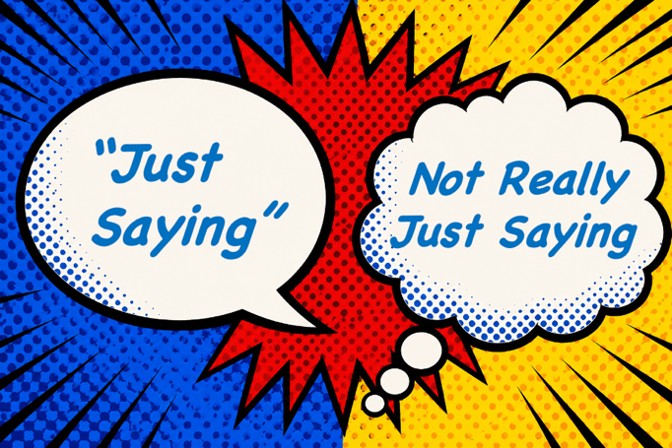
You’re Probably Not ‘Just Saying.’

During a focus group among foodservice professionals, one participant said to another …

… “your restaurant is never going to make money. I’m just saying.” The second participant neither appreciated nor agreed with this statement. But it started a good, if emotional, conversation.

At one point I quoted what the first participant had said, including the ‘just saying’ part, and asked why he had added that. He thought a bit and admitted that he had included it without thinking about it. Eventually he realized that he was trying to be less harsh. This led to further discussion about the intense emotional commitment restaurant owners make to their businesses, which surfaced important insights for the client, a food manufacturer.

‘Just saying’ is one of those phrases we sometimes use without thinking. It’s what’s technically called a discourse marker – something that indicates how somebody wants a statement to be interpreted. Specifically, it signals that the speaker wants the remark to be heard in a particular way – or to avoid responsibility for how it might be taken. As a qualitative researcher, I pay close attention to these markers, as they can be clues to hidden meaning. I’ve learned that when somebody adds in ‘just saying,’ they’re probably not just saying. While ostensibly it means that somebody is merely making an observation, it usually means more.

Specifically, it might indicate the speaker is trying to:

Soften criticism by making it seem less personal or confrontational.
Create plausible deniability if the remark is challenged or poorly received.
Imply something without stating it outright leaving the listener to connect the dots.

So, by exploring these markers when we encounter them and questioning why the speaker included one in a statement, we can learn more about a person’s true meaning and feelings.  In addition to ‘just saying,’ here are a few more discourse markers that I watch for, as they suggest veiled subtext:

‘For what it’s worth…’ signals modesty while asking the listener to take the opinion seriously.
‘No offense, but…’ acknowledges that offense is likely while attempting to soften it.
‘Don’t take this the wrong way, but…’ is a way to soften criticism.
‘With all due respect…’ marks disagreement while paying deference.
‘Not for nothing…’ suggests a point deserves more attention than it’s getting.
‘I’m just asking the question…’ frames an implication or challenge as mere curiosity.

So, when you notice a discourse marker in the course of conversation, dig in. You’re likely to learn a little more, and maybe even a lot more.

Posted in Marketing History.