“Frank, you have a phone call at the reception desk. Bring your coat.” The research facility manager said this to a participant in a focus group on refrigerators. Needless to say, Frank was done for the day. His sin: dominating the conversation.
Another story: two years ago I was working with a subcontractor who was underperforming. However, when our team brought up our concerns, he would respond at length, going off on 10+ minute monologues. We would interrupt to get the conversation back on track but then he’d be off on another monologue. Ultimately, we had to terminate the relationship.
This is a common problem – not letting others talk – and something we all do at least occasionally. It prevents true conversation, which requires listening and generosity. The objective isn’t just to say what you want to say.
Why do we do this? Here are some reasons people might refuse to yield the floor:
They don’t want to be challenged. If others can’t talk, they can’t question you or disagree. This can be a form of aggression.
Anxiety. Sometimes it’s nervousness. Talking becomes a mechanism to compensate for discomfort or an outlet for nervous energy. We may not even realize we’re doing this.
Inflated ego. Some people believe theirs is the only valid opinion, or just want to be the center of attention. This was probably the case with Frank the refrigerator owner.
So, what do we do? First, let’s agree it’s a problem. In business situations, one person monopolizing conversation makes productive discourse impossible. In social situations, such behavior can ruin the occasion.
There are several possible approaches to take in such a situation. First, try to get a sense of why a person won’t let anybody else talk, bearing in mind that it can be difficult to diagnose people’s motivations.
If it might be aggression, you could forcefully interrupt or end the conversation and resume it by other means (such as email). You’ll need to decide which approach might be more appropriate given the situation.
If it could be anxiety, find an inoffensive way to disrupt the pattern. For instance, you could acknowledge their feelings, take control of the conversation and provide a transition to another topic.
If it’s uncontrolled ego, you can remove yourself or the offending person from the conversation. That’s what happened to Frank. However, such actions can come at a cost, as they can create awkward situations.
Forceful interruption is an option but it’s risky; interrupting can be seen as rude and might lead to a confrontation. And a final thought – it might be you that’s the offender. Remember, we all do this, at least occasionally. Ask yourself this: “am I truly listening and genuinely interested in what the other person is saying, or am I just waiting for a chance to say my piece?”
Don’t forget: genuine conversation doesn’t just go one way. Remember that when you sit down to Thanksgiving dinner.

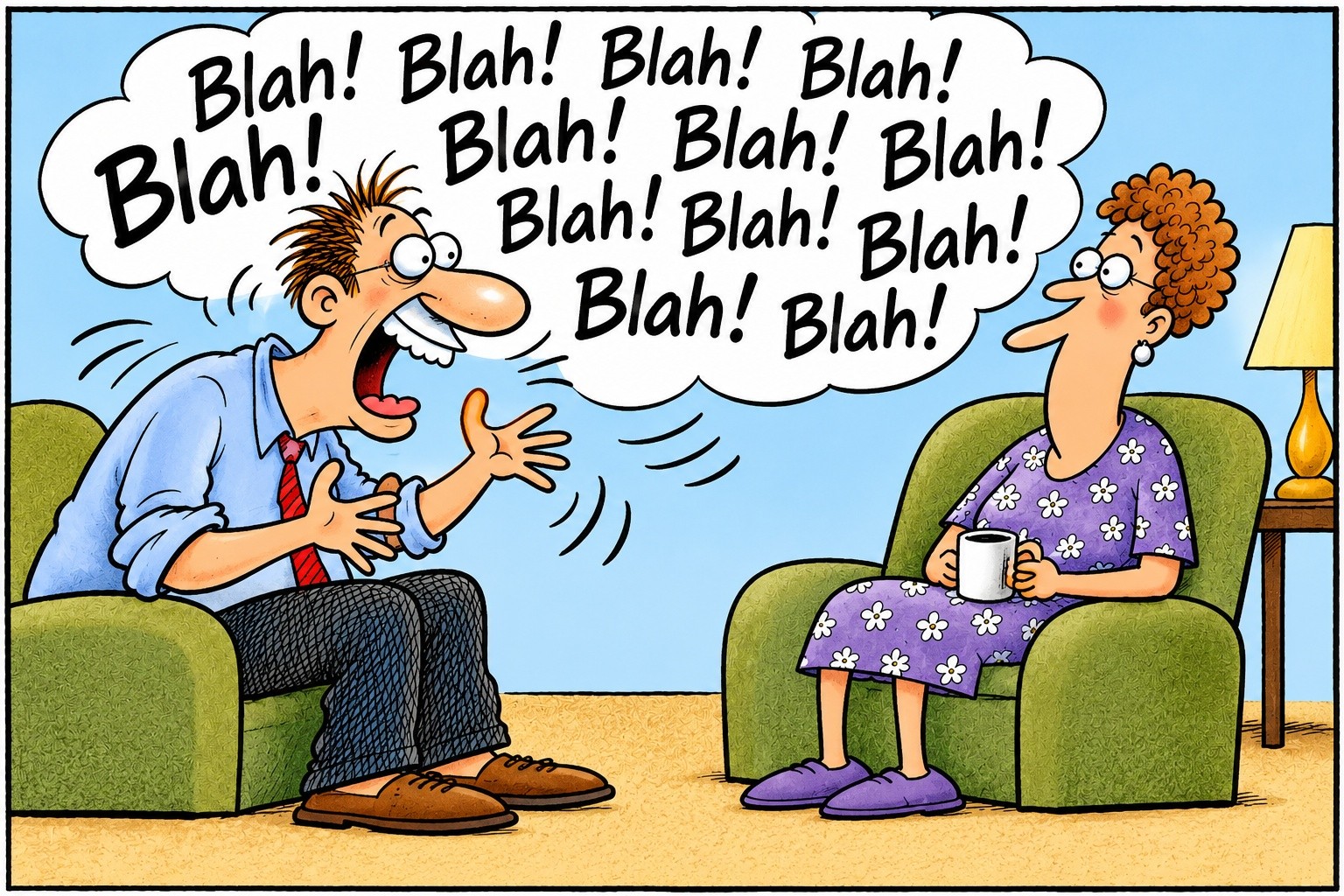 When conversation isn’t really conversation.